In 2000, the European Union and the African, Caribbean and Pacific Group of States, otherwise known as the ACP group, adopted the Cotonou Agreement, which is a framework treaty on trade, aid and political cooperation. It replaced the previous Lomé Convention, providing for a general set of privileged relations between the EU and the ACP countries in matters of market access, technical assistance and other issues. The objective is to facilitate the economic and political integration of the ACP countries into a liberalised world market over the next 20 years. Many ACP countries are LDCs (Least_Developed Countries).
Under the Cotonou Agreement, the parties agreed to negotiate a separate set of free trade agreements between the EU and the participating ACP countries, tailored to seven clusters of countries (East Africa, West Africa, Eastern and Southern Africa, Central Africa, SADC, the Caribbean and the Pacific). For the EU the EPAs are meant to be comprehensive free trade agreements, laced with rhetoric about "development" and "regional integration". For the EU, comprehensive means not just about the liberalisation of trade in goods, but also about liberalisation of services, investments and government procurement, and the strengthening of intellectual property rights, competition rules, etc.
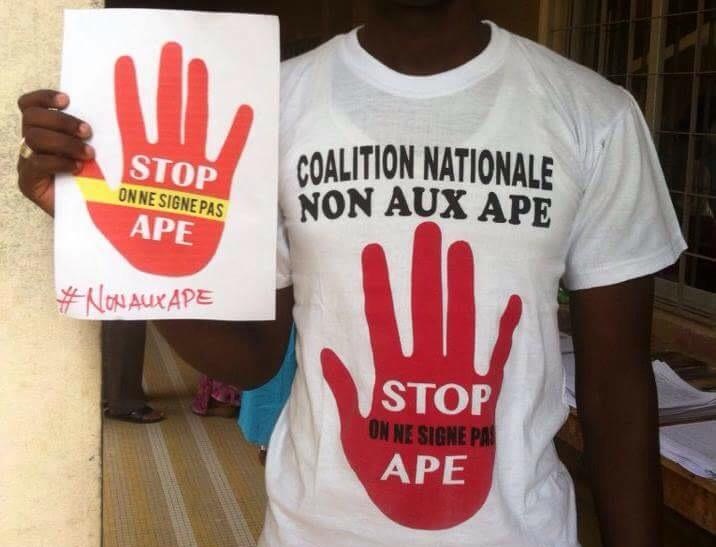
The negotiations on these EPAs started in September 2002 and were supposed to be completed by 31 December 2007. Hence, a WTO waiver to maintain the EU’s unilateral preferential trade relations with ACP countries until that date was sought and granted. (The EU pushed "WTO compatibility" of the EPAs as a frame for the talks and ACP countries accepted it.) As the talks advanced, ACP governments became caught between a rock and a hard place. They wanted the bits of market access that the EPAs offered, but would have to pay an extremely high price in terms of loss of customs revenue, destabilisation of their economies from the expected flood of EU imports, unclear financial aid commitments from Brussels, reduced political autonomy, etc. Civil society, labour unions and business groups in the ACP countries studied the implications and came out with vigorous campaigns to stop the signing of the EPAs.
The 31 December 2007 deadline for the EPAs to be signed came and went in a flurry of drama. Only the Caribbean region concluded negotiations on a comprehensive EPA before the deadline. A number of other states — including Papua New Guinea, Fiji, Ghana and Cote d’Ivoire — initialled bilateral interim EPAs on goods only, to secure the continuation of their exports. Others, like Senegal, swore they would not sign until “development concerns” were seriously taken on board. Negotiations then continued to revise the interim EPAs which appeared to contain many problematic provisions; and to arrive at regional agreements. In order to put pressure on the negotiations, the EU imposed a new deadline: (non- least developed country) ACP countries which had initialled or signed (interim) EPAs but did not ratify or start to implement these agreements before 1 January 2014 would lose their preferential market access to the EU. As a result of this threat, regional EPAs were initialled in the summer of 2014 in West, East and Southern Africa. However, the European Commission warned the three regions that it would withdraw preferential market access if these regional EPAs would not be ratified within two years. In the summer of 2016 the European Commission tabled the legal instruments to give effect to this threat on 1 October 2016. All targeted (non-LDC) countries (Ghana, Ivory Coast, Botswana, Namibia, Swaziland and Kenya) surrendered and “ratified”.
West African countries approved a regional EPA on 10 July 2014 but the agreement is yet to be signed by Nigeria (where it faces sustained opposition). Under pressure of the European Commission’s 2016 ultimatum, Cote d’Ivoire and Ghana therefore decided in August 2016 to ratify their old and outdated 2007 agreement. The Cote d’Ivoire interim EPA has been applied since 8 September 2016, the Ghana interim EPA since 15 December 2016.
The East African Community (or EAC) EPA was supposed to be signed in July 2016 but Tanzania announced that it was not ready to sign, as it wanted to further examine the effects of the EPA especially in the light of a possible Brexit. Under pressure from the EU, Kenya, the only non-LDC in the region, decided to sign and ratify the EPA on its own. In exchange, its export to the EU have continued to receive preferential treatment. Rwanda signed as well.
In Southern African, six member countries of the Southern African Development Community (SADC), namely Botswana, Lesotho, Mozambique, Namibia, South Africa and Swaziland, signed the regional EPA that they had initialled in 2014. The European Parliament approved it on 14 September 2016. Provisional implementation started on 10 October 2016.
In all other ACP regions (except the Caribbean) regional EPA negotiations failed completely: as a result a number of countries ratified or started to provisionally apply separate 2007 interim EPAs (most of them under pressure of the EU’s 2016 ultimatum): Cameroon, Zimbabwe, Seychelles, Madagascar, Mauritius, Papua New Guinea, Fiji.
Since then a number of ACP countries have decided to join existing EPAs, like Samoa, Tonga and the Solomon Islands in the Pacific and the Comoros in Eastern and Southern Africa. Angola is considering joining the Southern African EPA. These moves have much to do with the graduation of these countries out of their LDC status, and therefore also out of the EU’s duty free-quota free market access scheme (called Everything But Arms- EBA). These countries join EPAs in order to maintain their preferential access to the EU.
Nevertheless, only 13 African countries are implementing an EPA, and 12 have no EPA at all. In the Pacific so far only 3 out of the 14 countries have an EPA.
Below is an overview of the EPA’s state of play as of January 2020 (courtesy of Marc Maes):
| EU-ACP sub-group | status of agreement |
|---|
| Caribbean |
• full EPA initialed in Dec 2007 and signed in October 2008 (and December 2009 by Haiti) and approved by the European Parliament (March 2009). Ratification still pending in most Caribbean and EU states. Caribbean countries experience difficulties with the implementation of the EPA. Haïti does not apply the EPA. |
| Central Africa |
• interim EPA initialled (Dec 2007) and signed by Cameroon only (January 2009), approved by the European Parliament (June 2013), ratified by Cameroon (August 2016) |
| West Africa |
• interim EPA initialled by Côte d’Ivoire and Ghana only (Dec 2007) |
|
• this interim EPA signed by Côte d’Ivoire (Nov 2008) and approved by the European Parliament (March 2009) |
|
• Regional EPA (that would replace two interim EPAs) initialed in July 2016. 13 countries have signed this EPA; Nigeria has not |
|
• interim EPA ratified by Côte d’Ivoire in August 2016 and applied since 8 September 2016 |
|
• interim EPA signed, ratified by Ghana (Aug 2016) and applied since 15 December 2016 |
| East and Southern Africa (ESA) |
• This region originally comprised 16 countries, but fell apart at the end of 2007. Ethiopia, Eritrea, Djibouti and Sudan dropped out of the process; the EAC initialled a separate regional interim EPA (see below); so that only the following countries remained: Zimbabwe, Seychelles, Mauritius, Comoros, Madagascar and Zambia. These initialled the same EPA text in November-December 2007 but only Zimbabwe, Seychelles, Mauritius and Madagascar signed in August 2009). The European Parliament has approved this interim EPA in January 2013. Comoros signed in July 2017. All five countries are applying the agreement. In October 2017 they launched negotiations with the EU to expand and deepen the EPA. First negotiations took place on 14-15 January 2020 |
| East Africa |
• regional interim EPA initialled by East African Community members Burundi, Kenya, Rwanda, Tanzania, Uganda (Nov 2007) |
|
• revised and more complete regional EPA initialed in October 2014 |
|
• Kenya and Rwanda signed this EPA in September 2016, Kenya also ratified it |
| Southern Africa |
• regional interim EPA initialled by Botswana, Lesotho, Namibia, Swaziland, Mozambique (Nov-Dec 2007) and signed by Botswana, Lesotho, Swaziland and Mozambique only (June 2009) |
|
• None is implementing the agreement |
|
• revised and more complete regional EPA initialled on 15 July 2014; signed by Botswana, Lesotho, Namibia, Swaziland, Mozambique and South Africa on 10 June 2016 and ratified by all; ratified by the European Parliament on 14 September 2016; provisionally applied since 10 October 2016 |
|
• Mozambique ratified the EPA on 28 April 2018 |
|
• Angola has dropped out of the process but has an option to join the agreement in the future |
| Pacific |
• interim EPA initialed by Papua New Guinea and Fiji only (Nov 2007). Signed (July 2009) and ratified (February 2011) by Papua New Guinea; signed by Fiji (Dec 2009) and provisionally applied since July 2014 |
|
• Samoa acceded to this interim EPA in December 2018. Solomon Islands and Tonga are in the process of acceded in 2020 |
|
• 10 countries have not initialled anything yet |
last update: Fabruary 2020
photo: Coalition nationale Non aux APE/Facebook