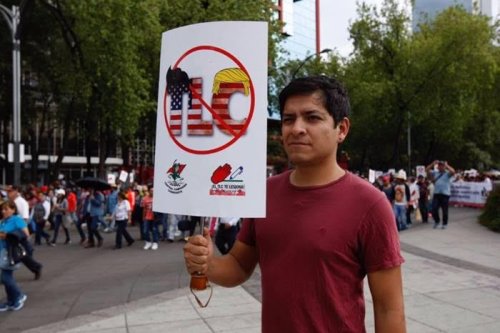
Joint declaration of the national gathering – advocacy assembly on the USMCA
October 21–22, 2025 | Mexico City
From our diverse backgrounds, we reaffirm our conviction that Mexico is an independent country that places life, dignity, and sovereignty above profit and the imposition of corporate interests.
For genuine regional cooperation based on justice. We call for the construction of a national and tri-national people’s agenda that centers on social, environmental, and gender justice, replacing the logic of competition with solidarity among peoples.
We call upon all organizations, communities, and social movements to continue this process of articulation, strengthen local and regional alliances, and join in building a collective voice in response to the USMCA.
We, representatives of social movements, Indigenous peoples, civil society, peasant, labor, academic, and human rights organizations from across the country, gathered at the Human Rights Commission of Mexico City on October 21 and 22, 2025, in the framework of the National Gathering – Advocacy Assembly on the USMCA, jointly declare the following:
At a decisive moment for Mexico, we recognize that the review of the United States-Mexico-Canada Agreement (USMCA) represents a turning point for our country. This is not merely a trade agreement: the USMCA has directly impacted the social, labor, food, environmental, cultural, migratory, energy, peace, and human rights dimensions of our national life.
More than three decades after the entry into force of NAFTA, now the USMCA, the people of Mexico continue to suffer the consequences of an imposed neoliberal model that has deepened inequalities, environmental damage, economic dependency, and the vulnerability of millions of workers, peasants, migrants, Afro-descendants, fishers, and urban dwellers. Beyond certain benefits of industrialization or economic growth, no modernization process can justify or compensate for the violations of human rights, the destruction of territories, and the undermining of the sovereignty of peoples.
While some producers have benefited, the USMCA has concentrated wealth in the hands of a few corporations and governments, precarized labor, displaced entire communities, degraded ecosystems, and weakened the State’s capacity to guarantee fundamental rights satisfactorily — a situation that must be overcome. In light of this reality, we affirm that sovereignty is non-negotiable, and that economic cooperation will only be just if it is based on equity, gender equality, cooperation, respect for peoples, and the guarantee of human rights above transnational corporate interests.
During this Gathering, we presented and discussed the progress of five thematic working groups that reflect the struggles and resistances of multiple social sectors:
Labor and Migration
We call on governments to redouble their efforts to strengthen the exercise of freedom of association and collective bargaining as the foundation for dignifying labor human rights. We demand that labor inspection and migration regularization be strengthened and given real meaning in practice, as effective tools to protect workers and not merely administrative requirements.
In an increasingly hostile context for labor, social, and migration rights, we reaffirm the importance of having trinational regulatory and coordination mechanisms based on common or harmonized minimum standards — but, above all, on genuine political will to ensure their enforcement.
Agriculture
We reaffirm the defense of food sovereignty as a fundamental principle in the face of the advance of the agroindustrial model and transnational interests that threaten our seeds, territories, and ways of life. We demand that corn and beans be removed from the USMCA and that the Agreement guarantee the protection of native seeds (opposition to adherence to UPOV 91, free of GMOs and agrotoxins), water, and territory, as well as the defense of biodiversity — all of which are now at risk from transnational land and resource grabs that prioritize profit over life. We recognize the urgency of promoting a comprehensive agricultural agenda centered on small and medium producers, peasant and Indigenous communities, and that ensures the full integration of women at all stages of the value chain. Such an agenda must guarantee seed traceability — especially of corn — and fair prices that strengthen local economies. The defense of territory and common goods is also a defense of the dignity and future of our peoples; thus, protecting and preserving water as a human right will be the basis for ecosystems and the right to food.
Environmental
We uphold the full enforcement of the Escazú Agreement and the precautionary principle as essential guarantees to protect life, territories, and peoples’ right to decide their own future. In the face of the business models promoted by the USMCA, we demand respect for the free participation of communities and peoples in all decisions that affect their environment, resources, and ways of life. Environmental justice and the defense of Economic, Social, Cultural, and Environmental Rights (ESCER) must be the starting point for any negotiation or policy stemming from international trade. Therefore, it is essential to recognize nature as a subject of rights under the stewardship of the communities inhabiting the territory.
We will actively participate in the UN Working Group sessions on developing a legally binding instrument to regulate the activities of transnational corporations and other businesses under international human rights law, and will elaborate our national position in consultation with relevant stakeholders. We will also promote the complete elimination of the Investor-State Dispute Settlement (ISDS) mechanism — as the U.S. and Canada have already done between themselves within the USMCA — which still obliges Mexico to grant foreign investors privileges above human rights.
Human Security and Peace
We call for the construction of true peace — one that is not limited to the absence of conflict or the expansion of military forces, but that addresses the roots of the structural violence affecting our communities. We advocate for a rule of law grounded in a human rights framework, free from military omnipresence, where justice, equality, and dignity are at the center of public action.
Eradicating violence requires transforming the conditions that produce it: impunity, corruption, distorted markets, social exclusion, and lack of access to fundamental rights. Likewise, the economic structures promoted by the USMCA contribute to violence, territorial destruction, and criminal governance. Only through the active participation of the people and the recognition of their voices can we build peace with justice and a dignified life for all.
As organizations and movements, we commit to:
- Build a national agenda that reflects the proposals and needs of the peoples in relations with the U.S. and Canada, including demands related to the USMCA review.
- Demand transparency and social participation in all international negotiation processes that affect the country’s rights and sovereignty.
- Articulate our struggles into a broad front that overcomes sectoral fragmentation and centers dignity, justice, and the self-determination of peoples.
- Recognize education, training, and popular wisdom as key elements to strengthen collective awareness of the USMCA’s impacts and its alternatives in social life.
- Create mechanisms for monitoring, foresight, and joint action — at both national and regional levels — to strengthen social actors and influence the three governments that signed the Agreement, as well as international bodies.
For a new relationship among the peoples of North America, we reaffirm that genuine regional cooperation cannot be based on competition or subordination, but on solidarity, mutual respect, wealth redistribution, sustainable economic development, and fair collaboration between peoples. Our proposal is to move toward a model of international relations grounded in social and gender justice, environmental sustainability, and respect for the human rights of all people.
We invite all individuals and movements to join this process of collective organization and construction. We recognize your struggles and resistance in defense of labor, territorial, biodiversity, and Indigenous rights, as well as your specific, yet interconnected, agendas that can be articulated with the demands of other social sectors.
We call on the governments of the three countries to recognize and value the creative capacities, proposals, and alternatives that their own peoples have to offer for the construction of life.
For the sovereignty, justice, and dignity of the peoples of Mexico.
Collective Signatories (open to Mexican organizations indefinitely):
1. Asamblea de Incidencia del T-MEC
2. Alianza Ríos Mayas
3. Aluna Acompañamiento Psicosocial
4. Amigas da Terra Brasil
5. Asociación Nacional de Empresas Comercializadoras de Productores del Campos, A.C
6. Asociación de Consumidores Orgánicos
7. Asociación Morelense de Lucha contra el Cáncer, A.C
8. Black Lives Matter South Bend
9. Brigada feminista
10. Centro de Estudios Ecuménicos
11. Centro de Reflexión y Acción Laboral
12. Centro Lindavista
13. Centro Solidario Tsomanotik
14. CESTA Amigos de la Tierra El Salvador
15. Coecoceiba-Amigos de la tierra Costa Rica
16. Colectivo Sí a la Vida
17. Colectiva Kataz Nodos de Autoformación
18. COLEFOM
19. COMCAUSA AC
20. Comisión de Solidaridad y Defensa de los Derechos Humanos, A.C.
21. Comité Fronterizo de Obreros AC
22. Consejo del Pueblo Maya, Guatemala
23. Encuentro Internacional de Economía de los Trabajadores
24. Eskuela Radical ESE-ERRE A.C.
25. Federación Internacional de Escritores por la Libertad
26. Festival internacional Esaú
27. FIAN México
28. Fortaleza Comunitaria Integral, A.C.
29. Frente petenero contra represas
30. Fundación para la Seguridad Alimentaria y el Apoyo a Mexicanos en Condición de
Pobreza, A.C
31. Fundación Monica Alejandrina por los derechos humanos
32. Fundación Semillas de Vida
33. Global Exchange
34. Grupo de Estudios Ambientales GEA AC
35. GUERREROS VERDES A.C.
36. Huerto Roma Verde
37. INDRA Red educativa para la preservación de semillas nativas
38. Instituto de Estudios Obreros “Rafael Galván” AC
39. International Rivers
40. Jtatic Samuel Ruiz Garcia A. C.
41. La Gremia, Red de Mujeres del cine y la tv.
42. Lawyers Guild-Task Force on the Américas
43. Maderas del Pueblo del Sureste A.C
44. Mexico Solidarity Project
445. Mexteki
46. Movimiento por la Defensa del Bosque y Cuencas de Agua de Tancitaro
47. Nosotrxs
48. Oceana
49. Otros Mundos Chiapas / Amigos de la Tierra México
50. ONG. Más Música, Menos Balas
51. Red de Mujeres Sindicalistas
52. Red Iberoamericana de Agenda 2030
53. Red Mujeres Unidas contra las violencias Jalisco
54. Red Cultura Viva Comunitaria Jalisco
55. Red Vive Libre Colectiva
56. REDES - Amigos de la Tierra Uruguay
57. Rip.mx / Adherente a la Sexta / Otros Horizontes Políticos
58. Scalabrinianas Misión con Migrantes y Refugiados-SMR
59. Servicios y Asesoría para la Paz
60. Tierra Nativa - Amigos de la Tierra Argentina
61. Tribunal Internacional de Conciencia de los Pueblos en Movimiento
62. Unión Campesina Democrática CDMX
63. Unidad Latina en Acción
64. Vía Orgánica
65. Witness at the Border/National