Where is globalisation headed?
By Achille Delaunay, Lecturer in International Trade
29 January 2026
Neoliberal globalisation has come to an end. Over the past fifteen years, a succession of economic crises, intensifying geopolitical rivalries, paralysis within multilateral institutions and popular resistance to free trade have profoundly shaken the organisation of international commerce as it took shape after the collapse of the Soviet bloc. Donald Trump’s presidencies accelerated this shift — the second appearing to deliver the final blow. For economic justice groups, this upheaval raises direct questions about the scope for political manoeuvre, potential alliances and imminent risks in a world where trade is increasingly used as a blunt instrument of power.
Globalisation: a contested political project
The shift in globalisation is not just a bump in the road. It signals a deep transformation of the world economy, its political balances and its power relations. Three economists offer complementary perspectives on what is at stake. In Chine / États-Unis, le capitalisme contre la mondialisation [1], Benjamin Bürbaumer analyses the Sino-US rivalry as a symptom of a structural crisis in globalisation. Branko Milanovic, in The Great Global Transformation: National Market Liberalism in a Multipolar World, focuses on inequality and on the winners and losers of global integration. Arnaud Orain adds historical depth with Le monde confisqué - Essai sur le capitalisme de la finitude (XVIᵉ - XXIᵉ siècle) [2]. These authors do not merely present abstract theories: they provide an essential framework for understanding today’s geopolitical turbulence.
These three works converge on the idea that globalisation has never been peaceful, neutral or egalitarian, echoing the message of anti-globalisation movements over the past decades. It has always been an economic, political and military battleground, dominated by large corporations closely intertwined with states.
Contemporary globalisation — a liberal political project under US supervision, built after the Second World War — has long been contested. In the Global South, promises of development frequently gave way to dependence, illegitimate debt and enforced specialisation within global value chains dominated by transnational corporations. In what Milanovic calls the “political West,” [3] rising inequality and deindustrialisation gradually eroded the social consensus around free trade.
Yet it was China’s rise that truly destabilised the architecture of globalisation — not because China stood outside it, but because it became one of its most accomplished products.
Paradoxically, the expansion of transnational capitalism in the 1970s and 1980s, in both the United States and China, laid the groundwork for the erosion of the liberal world order forty years later. Bürbaumer shows how China’s integration into neoliberal globalisation was actively supported by US capital, which saw in it a vast reservoir of cheap labour and a new arena for accumulation.
This integration took place under US supervision, through the World Trade Organization, global value chains and the dominance of the dollar. But the implicit assumption — that China would remain subordinate and compliant — proved mistaken. By building its own industrial, technological and financial capacities, Beijing gradually challenged the system’s hierarchy, in ways few had anticipated.
Here Arnaud Orain’s analysis comes fully into focus. Since the 16th century, he argues, capitalism has oscillated between brief liberal interludes and long phases of what he terms “capitalism of finitude.” Periods of liberal globalisation are short and depend on the uncontested hegemony of a power able to secure global trade flows, particularly maritime ones. Britain in the mid-19th century, then the United States between 1945 and around 2010, successively played this role.
The rest of the time, capitalism turns inward. Orain defines the capitalism of finitude as “a vast naval and territorial enterprise aimed at monopolising assets — land, mines, maritime zones, enslaved people, warehouses, undersea cables, satellites, digital data — conducted by nation states and private companies in order to generate rent outside the competitive principle.” While liberalism cloaks itself in a deceptively pacifying discourse, the capitalism of finitude is unapologetic, predatory and overtly violent.
Infrastructure and the Sino-US rivalry
China’s ascent marks the beginning of a new phase of finitude, finally closing the chapter of its “century of humiliation,” which began with the Opium Wars against Britain in the mid-19th century. By appropriating Western tools — the WTO, free-trade agreements — and bending them to its own interests, China has built its own international commercial networks. Bürbaumer stresses that the Sino-US rivalry is less about the global market itself than about its organisation and governance. Who sets the rules? Who controls infrastructure? Who captures added value? These are the questions that underpin today’s tensions.
Globalisation is not simply a matter of increased trade flows or the expansion of transnationals’ activities. It rests on material, digital and financial foundations whose control has become a central power struggle. Bürbaumer shows that it is now these infrastructures — ports, undersea cables, digital networks, payment systems, technical standards — that structure the Sino-American rivalry.
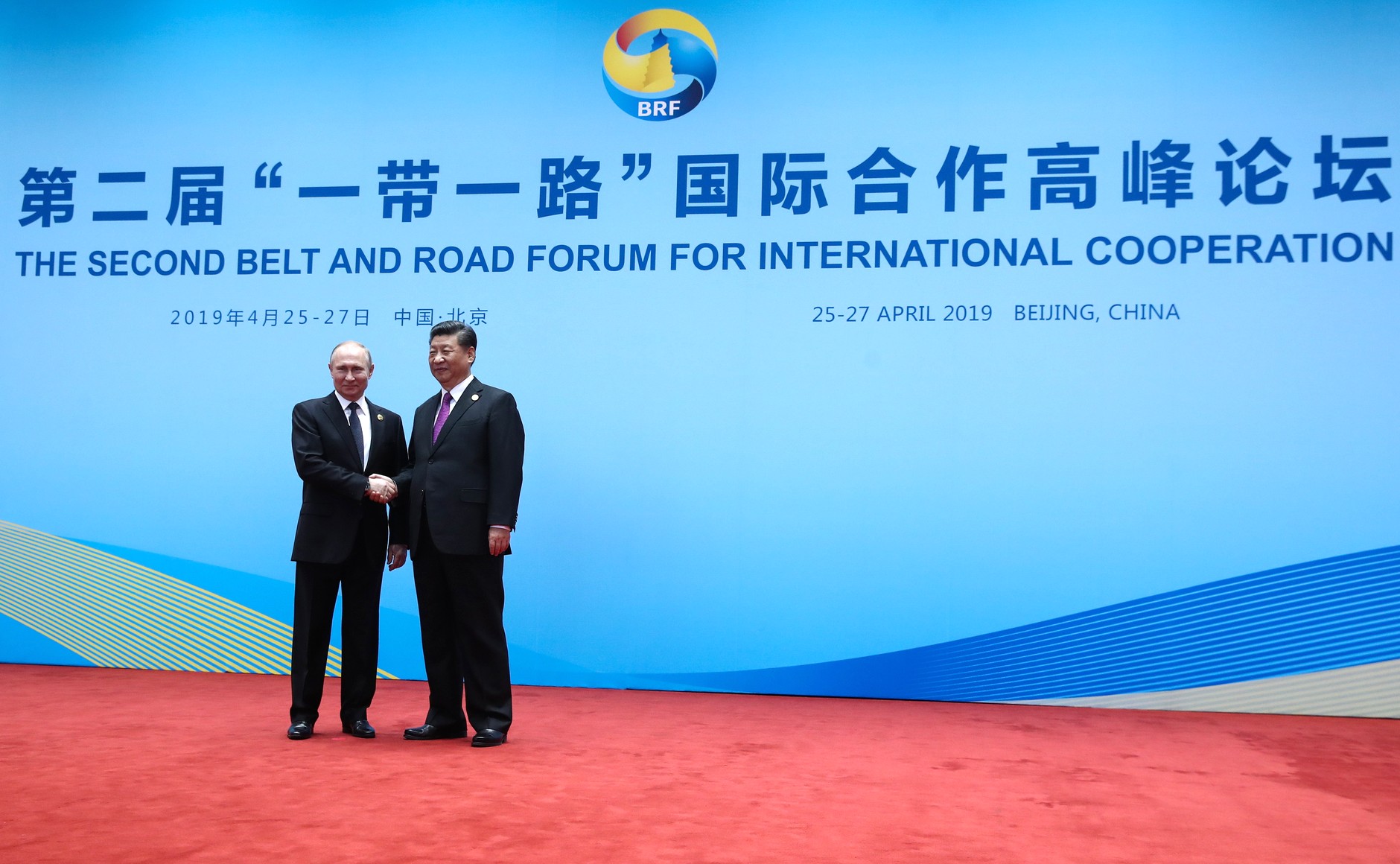
China’s Belt and Road Initiative sits at the heart of this strategy. Conceived as a response to domestic over-accumulation and the 2008 crisis, it aims to reshape globalisation under Chinese governance. Through land and maritime transport networks, trade agreements and special economic zones, the goals are twofold: to secure access to resources while bypassing US supervision, and to redefine the international division of labour in Beijing’s favour. The China-Pakistan Economic Corridor, which circumvents the US-monitored Strait of Malacca, is emblematic. But these projects carry heavy consequences for partner countries, often locked into the role of low value-added suppliers and sometimes crushed by unsustainable debt.
The battle over standards is just as decisive. In an economy organised around global value chains, setting standards determines what suppliers produce and how. China embedded this ambition in its five-year plan as early as 2015. Today, roughly 35% of contributions to 5G standards come from Chinese firms.
Digital technology is a major strategic area in this respect. While the United States retains an edge in certain infrastructures [4] and key components — notably semiconductors — China’s catch-up has been strikingly fast. Despite Western sanctions, Beijing is developing ever more advanced chips and extending Chinese-supervised infrastructure through its “Digital Silk Roads.”
Finance, however, remains an American stronghold. The dollar still dominates international trade, and its extraterritorial reach — especially through financial sanctions — gives Washington unparalleled political leverage. China is advancing the internationalisation of the renminbi, but structural limits remain. Against this backdrop, Donald Trump’s threat to impose 100% tariffs on any country seeking to replace the dollar as a reserve currency comes as little surprise.
Finance and digital systems thus create choke points controlled by a handful of firms, mobilised for geopolitical ends by their governments [5].
Dead ends of global trade
For Orain, this entanglement of monopolistic corporations and political power is a defining feature of the capitalism of finitude. Like the chartered companies of the colonial era — granted sovereign rights to develop activities in conquered territories while serving imperial interests — private accumulation today once again serves state power.
Economic concentration has reached dizzying heights. Walmart and Amazon dominate US retail; Maersk, MSC, CMA CGM and COSCO control most global shipping; over half the commercial seed and pesticide market is held by Bayer, Corteva, Syngenta and BASF [6]; and tech giants exercise near-sovereignty over digital spaces. In China, one of the largest waves of state-owned “mega-mergers” has unfolded since 2012. Concentration is also vertical, allowing transnationals to exert near-total control over value chains. After acquiring Bolloré Africa Logistics, for example, MSC took over railway lines inherited from French West Africa, such as the Abidjan–Ouagadougou axis, which still carries cocoa, coffee, peanuts, minerals and grain. Like the large colonial companies, Orain argues, these firms structure the global economy around warehouses, rents and monopolies. Adam Smith, the father of liberal economics, warned of the destructive effects of such companies during the colonial era, indifferent to the fate of the territories they exploited.
In this context, trade agreements are changing in nature. They are becoming explicitly geostrategic tools. Trump’s “tariff deals” revive a brutally imperial logic. Earlier initiatives under Joe Biden — such as the Indo-Pacific Economic Framework or the Americas Partnership for Economic Prosperity — already aimed to secure supply chains, as do many EU trade partnerships. Brussels has repeatedly highlighted the geopolitical importance of the EU-Mercosur agreement in a fragmented world. Similar dynamics are visible in India, which is multiplying trade deals. This logic of “friend-shoring” renews the concept of siloed trade, to the detriment of the most vulnerable Southern economies, often reduced to raw-material suppliers. Orain describes this as the “re-primarisation” of peripheral economies — another echo of colonial trade patterns.
What is the outlook for trade justice?
In The Great Transformation [7], published in 1944, Karl Polanyi already saw economic liberalism as containing the seeds of its opposite: an authoritarian, illiberal capitalism. Milanovic notes that thinkers such as Hobson, Rosa Luxemburg and Lenin reached similar conclusions. Trade driven by imperialist nations and firms, acting in concert to control Southern markets and natural resources by any means — including violence and forced labour — could only sow discord. Today’s rush for raw materials needed for the green and digital transitions fully confirms this dynamic, ushering in a new wave of extractivism that devastates ecosystems and displaces local communities and Indigenous peoples.
The capitalism of finitude, built on the appropriation of limited resources, intensifies rivalries and expansionist, warlike temptations. All three authors agree on one crucial point: this moment is less a break with neoliberalism than one of its outcomes. Milanovic recalls that market opening widened inequalities, enriched the top 1% and fuelled mass protest long ignored by an orthodox economics blind to its social effects. These fractures paved the way for figures like Trump and Xi.
The former World Bank economist anticipates the rise of “national market liberalism”: neoliberal economics maintained within borders, but with economic internationalism abandoned and social protections weakened. In this multipolar world, the BRICS countries challenge rules they see as biased in favour of the West, yet without offering genuinely emancipatory alternatives.
For Bürbaumer, the United States is now caught in what 1920s Italian activist Antonio Gramsci called the “hegemon’s trap”: when coercion outweighs consent, authority erodes. US influence is waning after decades of destructive neoliberalism and double standards. China may appear as an alternative for many countries, particularly in infrastructure and supply, but its power of attraction remains limited. The conditions for a prolonged confrontation are therefore in place.
Taken together, these books suggest the world is entering a period of lasting turbulence. If liberal capitalism and the capitalism of finitude ultimately serve the same interests, the latter does so with greater brutality. Milanovic ends on a bleak note: nationalism, greed and property will continue to shape the emerging world order.
Gramsci’s own fate — dying in fascist prisons in 1937 — seems to embody this pessimism. Yet his legacy also reminds us of questions that remain relevant today: why did progressive forces fail? What lay behind Mussolini’s popularity? How are our worldviews formed?
Ultimately, no positive outcome will emerge without a profound ecological and democratic rupture, grounded in major economic and political shifts in power relations — both between countries and within them. Without a re-engineering of global governance to serve people rather than capital, the far right will continue to exploit the cracks of a decaying system.
These analyses provide essential tools for understanding new fault lines and, while they may not offer immediate answers, they help to identify the right questions to ask.
• Benjamin Bürbaumer, Chine / États-Unis, le capitalisme contre la mondialisation (La Découverte, 2024) [8]
Benjamin Bürbaumer is an economist and senior lecturer at Sciences Po Bordeaux, specialising in globalisation and international political economy.
• Branko Milanovic, The Great Global Transformation: National Market Liberalism in a Multipolar World (Allen Lane, 2025)
Branko Milanovic is a senior scholar at the Stone Center on Socio-Economic Inequality at the City University of New York and visiting professor at the International Inequalities Institute, LSE. Former chief economist in the World Bank’s research department, he specialises in income inequality.
• Arnaud Orain, Le monde confisqué - Essai sur le capitalisme de la finitude (XVIᵉ - XXIᵉ siècle) (Flammarion, 2025) [9]
Arnaud Orain is an economist and historian, and director of studies at the École des Hautes Études en Sciences Sociales.