Vía Campesina | 29 March 2026
Yaoundé declaration: The WTO And free trade cause hunger, poverty and inequality
A new trade framework based on food sovereignty is urgent and necessary!
—————————-
For nearly thirty years the establishment of the World Trade Organisation (WTO), peasants’ organisations gathered in Cameroon have concluded that the WTO and free trade agreements hinder the development of countries in the Global South and lead to the ruin of small-scale producers worldwide, increased global hunger, increased indebtedness, environmental destruction and rising inequality. We call for the creation of an alternative to the WTO: a new trade framework based on food sovereignty and international solidarity.
———————————–
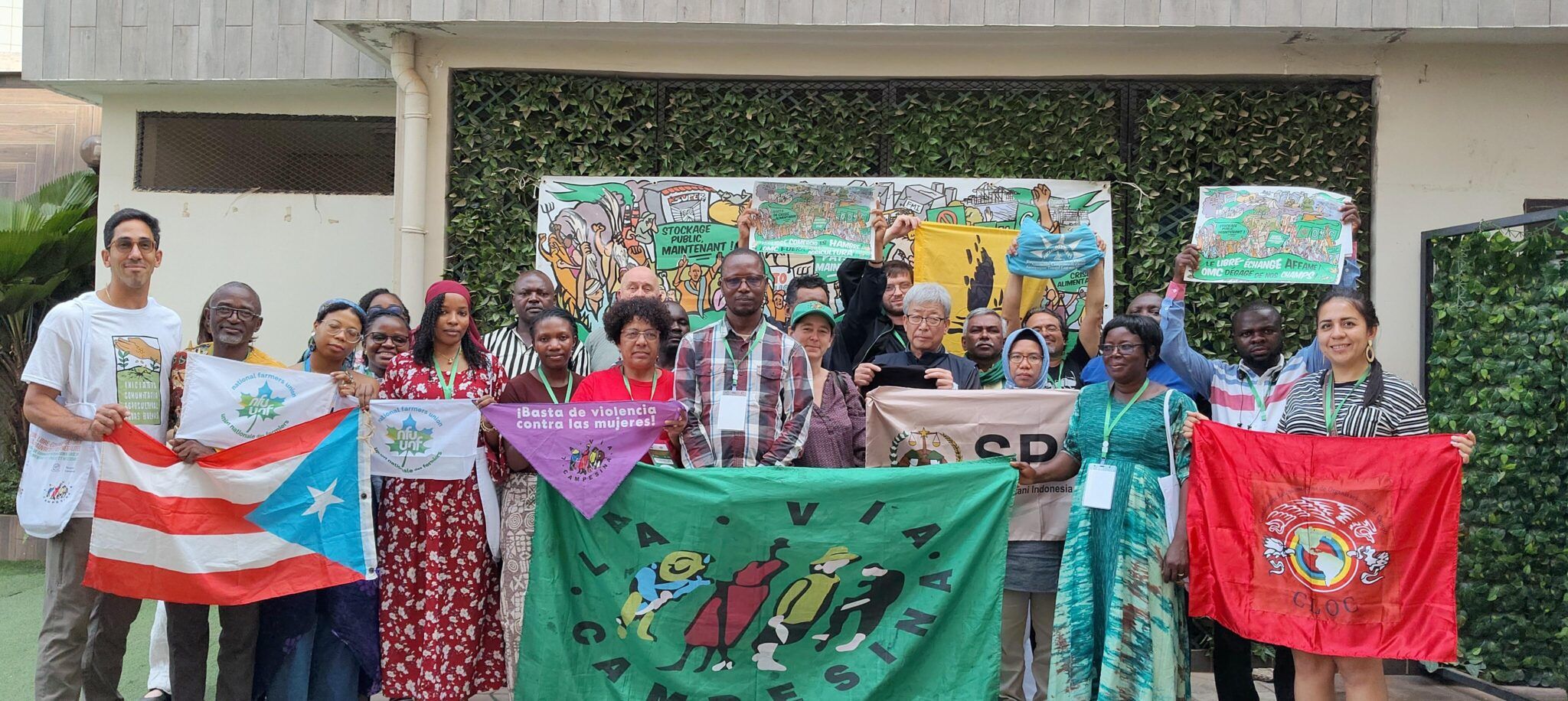
We, peasants from Africa, Latin America and the Caribbean, Europe, Asia, the Arab world, and North America, met from 24 to 29 March 2026 – on the sidelines of the 14th Ministerial Conference (MC14) of the WTO – to struggle against neoliberal trade and food regimes, under the WTO and Free Trade Agreements (FTAs). We were also here to exchange views with Cameroonian peasants, to learn about the realities faced by our allied small-scale fisherfolk movements, and to strengthen solidarity within the global peasants movement.
We are deeply grateful for the incredible hospitality shown by the Central African regional platform of peasants’ organization, PROPAC.
We solemnly address the states, and in particular the states of the Global South:
It is high time to carry out a critical assessment of the effects of the WTO. None of the ‘fine promises’ regarding a so-called ‘development round’ have been kept. On the contrary, the WTO – in it’s 28 years of existence – continues to be an instrument of domination by the big powers of the Global North against the economic sovereignty of the countries of the South.
Small-scale food producers have suffered under the capitalist and neoliberal ideology, which forces countries to abandon their food sovereignty in order to import foodstuffs from the other side of the world at the lowest possible price.
Today, the imperialist war imposed by U-Israel on Iran is leading to a massive disruption of global trade flows, and the countries that agreed to sacrifice their food sovereignty now find themselves trapped. The lesson is clear: making a population’s food supply dependent on international trade flows is suicidal. Weaponization of food as a method of collective punishment of the peoples’ is condemnable and must be strongly resisted.
Every country has the right and the duty to defend its food sovereignty, so as to ensure that its population has enough to eat. To this end, small-scale producers, peasants, fishers, pastoralists and Indigenous Peoples must be protected and supported, for it is they who produce healthy food for over 70% of the world’s population.
We closely monitored the negotiations at the MC14.
As usual, rich countries and major exporting nations attempted to impose a new round of liberalisation, pushing for greater market access for agribusiness and transnational corporations and pushing privatization for a reduction in public support for small-scale food producers.
We deplore the fact that at MC14, they succeeded in imposing a fisheries agreement that will prevent countries in the Global South from providing adequate support to small-scale artisanal fishers, whilst giving free rein to industrial fishing that is destroying the oceans. The rich and agro-exporting countries are now proposing a ‘reform of the WTO’ and a ‘new approach’, which means even more neoliberalism and the globalisation of trade dominated by transnational corporations.
The position of the African group of countries seemed to us by far the most favourable to the interests of rural populations: African states recognise the importance of food sovereignty, fair prices for small-scale producers, public stocks and public support for local production. We welcome these positions.
However, it has now been more than 25 years, since the Doha Ministerial, that the countries of the South have been calling for food security, public stocks, special and differential treatment and special safeguard measures to be prioritised, and for 25 years they have not been listened to. At the 14th Ministerial Conference on Food (MC14), they were once again completely overlooked.
We are not surprised.
La Via Campesina realised as early as the 1990s that economic globalisation and free trade agreements – and in particular the integration of agriculture into the WTO process – would prove devastating for small farmers across the globe, in both the North and the South. We have seen that cheap imported foods are destroying local food systems. It is driving small-scale producers to ruin and forcing them to abandon their farms, migrate and become informal migrant workers in the urban areas.
Migrant workers are one of the main victims of this neoliberal system, deprived of their livelihood at home and exploited in their host countries by being forced to work in industrial agriculture for low wages and under working conditions akin to slavery. Free trade agreements and their investment chapters lead to the grabbing of land, water and territories by multinational corporations, which drive out rural populations and ravage our environment.
From Seattle to Cancún, from Hong Kong to Nairobi, from Buenos Aires to Geneva to Cameroon, we have risen up to say ‘No to the WTO’. We are opposed to all free trade agreements: no trade agreement should force a country to import foodstuffs that destroy its local food production.
Our job as peasants or artisanal fishers is not to compete with small-scale producers on other continents; our job is to produce healthy food for our fellow citizens in our territories, whilst protecting the environment.
We have decided never to work with the WTO, and to this day we reaffirm that we are not interested in negotiating with the WTO. We are convinced that no reform can turn the WTO into an institution that serves the people; that is why we maintain that the only useful reform would be the outright abolition of the WTO.
We note that the WTO is well on the way to disappearing, particularly since President Trump decided in 2016 to stop appointing judges to the Appellate Body of the Dispute Settlement Body. The WTO has lost everything that made its decisions binding. As the Trump’s imposed tariff wars have shown, the WTO has become irrelevant and a zombie organisation, brain-dead but whose ghost still haunts us.
The big powers, led by the United States, have no qualms about openly flouting all WTO rules. We call on the countries of the South to do the same, particularly in order to develop measures to support and protect their local food production.
The European Union, Brazil and China are attempting to save face by promoting an appeal mechanism, the Multi-Party Interim Appeal (MPIA): we call on the countries of the South to refuse to join this mechanism, which will only work at their expense.
NOW IS THE TIME FOR AN ALTERNATIVE!
It is time for all countries that are genuinely concerned about the well-being of their people to work towards building an alternative to the WTO based on food sovereignty, the self-determination of peoples and international solidarity.
Since 2022, La Via Campesina has been working to build a new trade framework based on food sovereignty. We have exchanged views not only with peasants from La Via Campesina, but also with other global movements representing fishers, pastoralists, Indigenous Peoples, urban workers’ movements, and others.
We are now very proud to publicly present our proposal.
Our proposal is based on the primacy of food sovereignty: food is a right, not a commodity, and all peoples have the right to determine their food systems and the public policies best suited to supporting small-scale producers.
We believe that trade law must be subordinate to human rights, and in particular to the rights of Indigenous Peoples (UNDRIP) and the Rights of Peasants and Other People Working in Rural Areas (UNDROP), as well as to Workers’ Rights (ILO). We advocate that trade must be reimagined as an instrument serving the common good, peoples self-determination and leading to shared prosperity among nations.
We invite all countries, and in particular those of the Global South, to work with us within the United Nations to build together this new trade framework based on food sovereignty.
The legitimate forums for negotiations on agriculture, fisheries and food are the World Committee on Food Security (CFS), FAO and UNCTAD. We are aware that this process will take time, but it is time to set to work to rebuild an economy based on human dignity and the sovereignty of peoples.
Globalize the Struggles, Globalize Hope !