bilaterals.org logo
bilaterals.org logo

digital economy | e-commerce


EU-US trade talks could become ’another Acta’
EU-US free trade talks risk following the same path as Acta, the controversial anti-counterfeit treaty which collapsed in 2012, warns BEUC, a pan-EU organisation representing consumer groups
Trade pact would make internet services more expensive
The TPP may effectively force the entire Internet Service Provider (ISP) industry to become the street cops for the movie and music industry.
TTIP: Data is the elephant in the room
Data protection issues have been cut out of the negotiations for the Transatlantic Trade and Investment Partnership, but rivalry between the two trade blocs in the critical booming sector threatens to spoil any deal.
Data secure status for India is vital: Sharma on FTA with EU
India has a "very good agreement on table" for the European Union on bilateral free trade pact but data security status is all important for the country, Commerce and Industry Minister Anand Sharma said today.
To counter secret negotiations over TPP, coalition sets up open alternative
In response to this unnecessary and dangerous secrecy, a bunch of organizations have set up the "Fair Deal Coalition," and set up a website that basically does what the TPP and TAFTA negotiators should have been doing all along: creating an open platform, letting any stakeholder discuss the kind of things that should go into such an agreement.
NSA surveillance debate could threaten US-EU trade deal
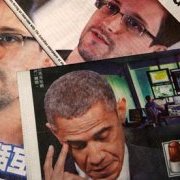
The furor over U.S. Internet surveillance could hit transatlantic trade. A senior European lawmaker says the revelations could potentially derail plans for a U.S.-EU free trade deal.
Consumer groups worry US-EU trade pact will weaken health, privacy regulations
US consumer groups raised concerns on Wednesday about the proposed free trade agreement between the US and the EU, which they said could weaken government health, environmental and food safety regulations and undermine privacy on the Internet.
Differences in prominent US and EU treaties concerning liability for service providers
A comparison of language between two of the most substantive and recent free trade agreements (FTAs) adopted by the US and the EU for one controversial area of IP: liability for internet service providers (ISP) for infringing content.
Trade Commissioner: EU to seek GIs in US FTA, but no new ACTA
EU trade commissioner Karel De Gucht said he did not want to reopen the discussion on Anti-Counterfeiting Trade Agreement (ACTA), which he called “a nail to my coffin.” As long as there is no respective EU legislation with regard to copyright protection on the internet, he will not try to “bring it in through the backdoor,” he said.
U.S. seeks Internet data flow safeguards in Asia-Pacific trade pact
The United States is asking countries for strong rules to protect the free flow of data, ranging from video clips to back-room office operations, in talks on a Asia-Pacific free trade agreement, a U.S. official said on Friday.
The Pacific free trade deal that’s anything but free
Just Foreign Policy is offering a reward, now up to $21,100, to WikiLeaks if it publishes a draft copy of the TPP. People could add to the reward fund, or if in a position to do so, make a copy of the draft agreement available to the world.
EU parliamentarians reject ACTA
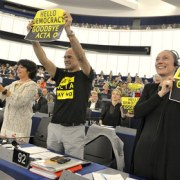
The EU Parliament has rejected the controversial global Anti-Counterfeiting Trade Agreement. The decision is a victory for thousands of Europeans who took to the streets in furious protest against ACTA.
MEPs to ’finish off’ ACTA on 4 July
A European Parliament Committee rejected the Anti-Counterfeiting Trade Agreement (ACTA) yesterday despite pro-business lobbying by Trade Commissioner Karel De Gucht, who insisted that Parliament should not decide before the European Court of Justice gives its opinion. A final vote in the full Parliament is expected on 4 July.
More tumult at the TPP: Secret negotiations against internet freedom continue in Chile; Big Pharma allies attempt to shut down critics’ event (again)
Talks on the Trans-Pacific Partnership Agreement, which the US is negotiating with Australia, Brunei, Chile, Malaysia, New Zealand, Peru, Singapore and Vietnam are continuing this week (April 9-13) in Santiago, Chile in the form of an “intersessional meeting” on intellectual property – focusing on internet policy.
Special report: TPP negotiations to heat up in Melbourne over patents, copyright, medicines
The TPP is gaining attention throughout the world not only because it holds the promise of opening up markets in participating countries and exporting stronger intellectual property protections enjoyed in the United States, but because some fear a greater backlash could ensue in the wake of outcry over the Stop Online Piracy Act (SOPA) and the Anti-Counterfeiting Trade Agreement (ACTA).
Keeping SOPA measures out of trade agreements ACTA, TPP
As protests against the Anti-Counterfeiting Trade Agreement (ACTA) sweep across Europe, two conclusions are possible: the era of closed-door IP policy is over; and the content industry’s insatiable quest for more power and control is no longer irresistible.
ACTA opponents welcome Germany’s decision
Opponents of the Anti-Counterfeiting Trade Agreement (ACTA) welcomed the official decision by the German government today to wait for action from the European Parliament before signing the treaty, calling it a sign that the debate over the balance between copyright protection and Internet freedom has become more explicitly political.
ACTA and TPP: The new enemies of the World Wide Web
The Anti-Counterfeiting Trade Agreement (ACTA) and Trans-Pacific Partnership Agreement (TPP) are essentially an alteration to SOPA and PIPA for the rest of the world.

ACTA protests lead EU Governments to suspend endorsement of the text
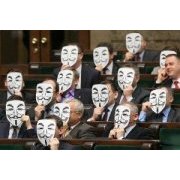
Poland, Slovakia and the Czech Republic have announced that they will delay their endorsement of a controversial trade agreement following a tide of public protest.
ISPs targeted in Pacific trade agreement
Representatives from Australia’s internet industry have called for full disclosure of a proposed free trade agreement between the United States and its allies in the Pacific, concerned that the deal asks ISPs to shoulder onerous burdens around copyright infringement.