- Negotiations

Having signed a Trade and Investment Framework Agreement on 10 May 2004, the US and Malaysia agreed in early 2006 to start negotiating a bilateral Free Trade Agreement. US negotiators indicated that they expected to conclude talks by the end of 2006 but that was not to be.
The Malaysian government has been putting up a fight on various issues such as government procurement (which Malaysia does not want to open to US participation) and its Bumiputra policy (giving special preferences to ethnic Malays). Social movements, on the other hand, reject the talks particularly in terms of the implications of a deal on access to medicines, intellectual property and Malaysia’s autonomy to set policies. The negotiations have stalled since 2009, and are now effectively on ice.
last update: May 2012
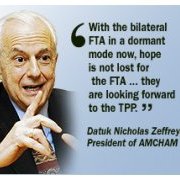
Photo: Third World Network
25-Apr-2025
Reuters
Malaysia is open to negotiate with the United States on non-tariff barriers and reducing its trade deficit and will explore a bilateral trade agreement, its trade ministry said.
7-Sep-2017
Bernama
“Now without TPPA, we are thinking of having an upgraded version of TIFA with the US, as TIFA is an agreement to go towards the goal of establishing a free-trade agreement at the end,” Second International Trade and Industry Minister Datuk Seri Ong Ka Chuan said
12-Mar-2010
Channel News Asia
Malaysia said Thursday that negotiations towards a bilateral trade pact with the United States have been shelved and it is now considering joining a regional deal promoted by the US.
3-Feb-2010
Business Times
US businesses in Malaysia said a broader trade pact like the Trans-Pacific Strategic Economic Partnership Agreement will provide better results than the stalled US-Malaysia free trade agreement (FTA) talks.
19-Nov-2009
Trade Minister Datuk Mustapa Mohamed hopes to find out in a few weeks if the country should still pursue a free trade area deal with the US, its biggest trading partner, or join a regional pact instead.
11-Nov-2009
The dialogue between Malaysia and the United States on the Free Trade Agreement (FTA), stalled since the middle of last year, has seen no new development, said the Minister of International Trade and Industry Datuk Mustapa Mohamed.
29-Sep-2009
Business Times
One obstacle in US-Malaysia Free Trade Agreement talks may be taken off the table following high-powered discussions on government procurement between the two trade partners.
3-Sep-2009
Business Times
The US is keen to sign a free trade agreement with Malaysia and to use it as a role model for the world’s largest economy to sign similar agreements with other Muslim countries, says the executive director of the Malaysia Institute of Economic Research
22-May-2009
Bernama
US Ambassador to Malaysia James R.Keith said the Obama administration was in the process of reviewing aspects of the agreement and would speed up the new round of talks with Malaysia.
7-May-2009
Bernama
Liberalisation of the financial sector will facilitate the free trade agreement (FTA) negotiations between Malaysia and the United States, International Trade and Industry Minister Datuk Mustapa Mohamed said today.