bilaterals.org logo
bilaterals.org logo

United Kingdom

Britain’s vote to leave the EU opens up the possibility of dozens of dangerous trade deals being negotiated with far-reaching effects across the world.

The desire to have an independent trade policy was a key motivating factor for leading proponents of leaving the EU. Through this trade policy, right-wing think tanks and politicians hope to move the British economy closer to the US model of deregulation and liberalisation, and away from what they see as the over regulated protectionism of the European Union. What’s more, they hope to trade far more with emerging and developing economies, building on what they see as Britain’s glorious history of global free trade.

These trade deals could have a serious impact on Britain’s public services and food standards, and threaten to make Britain an even more finance-dependent economy, deeply centralised and unequal – ironically the very conditions that gave rise to Brexit. But the impact globally could be even more serious, as the British government threatens to go into bat for big corporations, using intellectual property, e-commerce, investor protection and procurement rules to rip away standards and regulations that developing countries employ to protect their people, their environment and their right to economic development.

Britain’s new system for negotiating and ratifying trade deals is deeply undemocratic, with the public having no right to information, and members of parliament unable to properly scrutinise, nevermind stop, a trade deal. So the struggle for basic accountability and transparency is one that must go hand-in-hand with attempts to stop dangerous trade deals.

Britain is now a deeply polarised country, where nothing is certain. With Britain’s relationship with the EU unresolved, it is difficult to even know which areas of trade Britain will be able to negotiate. The most ardent free traders tend to favour a ‘no-deal’ Brexit, leaving Britain free to pursue the most extreme free market pacts possible. On the other side, the positive opportunity presented by the current moment is that it has reawakened interest in trade and presents an opportunity to inform the public that a modern trade deal extends well beyond tariffs and quotas. Completely new ways of ‘doing trade’ are being discussed and proposed within political parties in a way not known for many years.

Britain has been seeking to roll over 40 trade deals signed between the EU and third countries, including South Korea, Japan, Canada, Carribbean states, Central America, East and Southern African states. New trade deals with Australia, New Zealand and the US have also been identified as priorities.

Contributed by Nick Dearden, Global Justice Now (last update: August 2019)

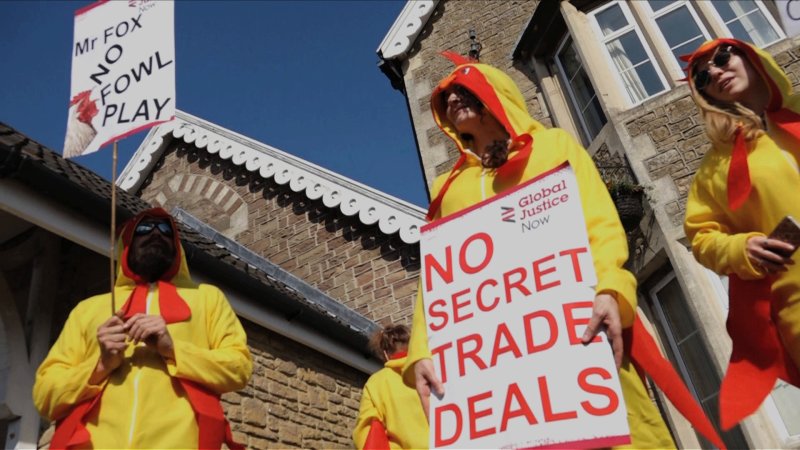
Photo: Global Justice Now


Gulf trade deal could ‘lock in’ more rights for fossil fuel industry, campaigners warn
UK government reported to be demanding corporate courts as a red line in deal with six Gulf countries.
Türkiye, UK complete 2nd round of talks on upgrading FTA
Türkiye and the UK are set to hold a third round of negotiations after the second in September to reach a "next-generation" and comprehensive free trade agreement to replace the existing one since 2021.
Trump tariff threats punch holes in UK trade deal
A flurry of new tariff announcements on pharma, trucks and movies have left British officials scrambling to keep up.
Unequal partnerships: who’s really gaining from US-UK tech deal?
The deal represents the latest entrenchment of a few giant US tech firms and their influence over the UK’s economic and political future. In addition, the deal risks weakening the UK’s ability to regulate the digital economy.
Joint statement: Human rights concerns regarding the UK’s Free Trade Agreement with the Gulf Cooperation Council
A coalition of rights groups and trade unions express deep concern around the lack of transparency and rights protections in the forthcoming Free Trade Agreement between the United Kingdom and the Gulf Cooperation Council
UK must stand with Global South against unfair US trade tactics
As the next US-imposed tariff deadline of 1st August looms, a coalition of trade justice campaigners are urging the UK Government to speak out against Donald Trump’s escalating tariff threats, warning that they will deepen economic hardship in Global South countries.
UK-India FTA: a missed opportunity for a fairer, greener trade agenda
The UK–India Free Trade Agreement marks a milestone in UK trade policy, but without binding commitments on rights, climate or accountability, it falls short of delivering a truly progressive deal.
Türkiye, UK conclude 1st round of free trade agreement negotiations
Updated FTA to include new provisions for trade in agricultural products, services and investments as next round of talks to be held by end of 2025, Türkiye’s Trade Ministry says
UK-US tariff deal begins but still no news on steel
A deal to cut import tariffs between the US and UK has come into force, giving British car makers preferential access to the world’s biggest consumer market.
UK-GCC free trade deal nears finish line, promises $10.8b boost to two-way trade
The United Kingdom and the Gulf Cooperation Council are in the final stages of negotiating a Free Trade Agreement, a deal first launched in June 2022.

    Links


  • The UK’s trade agreements
    UK government trade portal where trade agreements that the UK is negotiating and that the UK has already signed can be found, including texts of agreements.